GEORGETOWN – If you want to speak to the SelectBoard here in the future, you can address the five-member board for three minutes, but only if you want to talk on one of the topics already on the board’s agenda.
If you want to speak about a different subject, you must get a SelectBoard member to add it to the agenda or wait until the next meeting, usually two weeks later.
Town Administrator Orlando Pacheco is adding instructions to the agenda so potential speakers know what the new rules are.
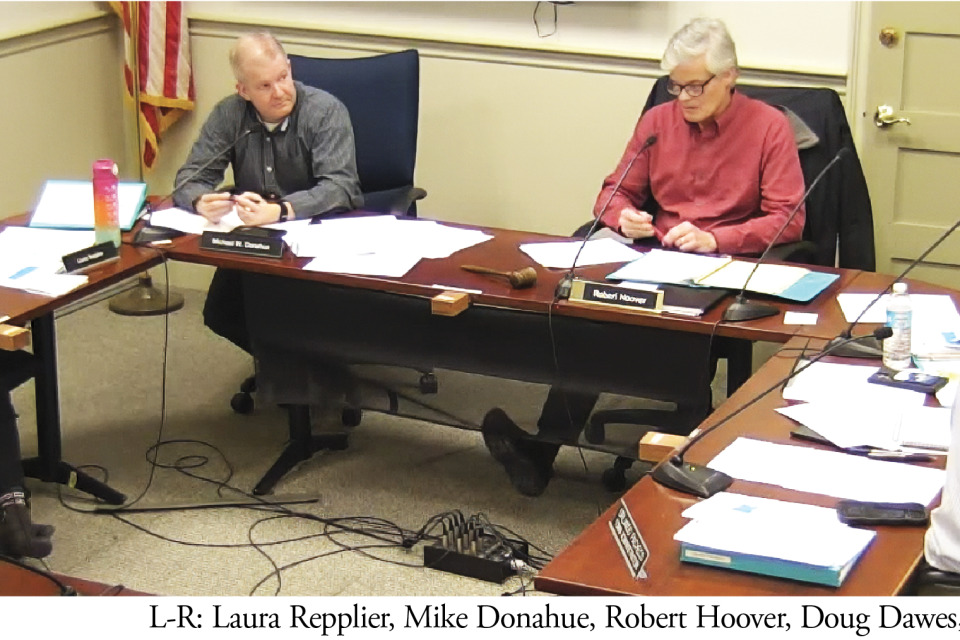
The issue of regulating public comments was one of the hot topics last week, lasting more than an hour at the regular SelectBoard meeting. Some board members, led by Laura Repplier and Doug Dawes, favored fewer restrictions. Robert Hoover initially favored requiring a four-business-days-notice for any comment. Hoover said that would increase “transparency” and give the SelectBoard more time to determine if it was an appropriate topic, and allow the board to engage in open dialogue at the meeting, otherwise, the board could risk breaking the open meeting law by discussing a topic which was not on the agenda.
Excerpts of the Initial One Hour and 11 Minute Georgetown Select Board Discussion Regarding Establishing a Formal Public Comments Policy
Georgetown Select Boad Chair Robert Hoover navigated his board through an initial discussion last week regarding a desire to establish a formal public comments policy. As Hoover pointed out, the board is faced with a tough balance of finding a way to allow the public to engage the board, in multiple ways (comments, agenda items, full discussions, etc.), while being transparent to the public as to what will occur, as well as enable the board to respond to public comments and not run afoul of public open meetings laws.
In most instances, if someone just shows up to a meeting and makes comments, the board cannot engage in a discussion, for example, to find a solution to their problem, as the issue was not disclosed to the public before the meeting, as an agenda item.
After the more than hour-long discussion, no formal vote was taken by the board, but the members agreed to do two things: 1. Continue discussing ways to allow the public to engage their Select Board, and 2. Add a note to the formal agenda requesting persons to limit any comments to a listed agenda item (so a member of the board could respond without breaking the Open Meeting Law), and encourage the public to contact the board via e-mail, phone, or in-person in town hall to request that an item be placed on the agenda.
Some excerpts from the discussion and summaries of the discussion
follows:
“All public comments and questions should be directed to the Select Board only. All speakers may speak only after first being recognized by the chair,” Hoover stated, explaining in detail that it would be inappropriate to repeat past performances where a member of the audience took an opportunity to speak and call-out an individual on the board or the audience.
Hoover sought to have speakers fill out a form, stating their name, address, contact information, and the topic they wish to speak on. “It’s oftentimes difficult to understand when someone says their names,” and he wanted the board to be able to follow-up with the person. “During regular scheduled Select Board meetings, individuals who previously submitted a public comment form … will have their opportunity to speak during the posted agenda’s public comment item,” he proposed.
“The public I think needs to also know, it’s about transparency, I think. The public needs to know what is going to be talked about if we’re going to have the most transparent way of working all of this. And so, in order for the public to get this information, it makes sense that they know it’s coming. And then the same goes with the Board of Selectmen needing to know and not have major surprises over something that is not only not anticipated, but could be very disruptive at that point in time,” Hoover said. “It would address these open meeting law complaints so that they wouldn’t happen and we wouldn’t have to spend the time and the back and forth on an open meeting law complaint … The goal is to eliminate these open meeting laws showing up and to do that to be transparent and have a well-organized efficient meeting.”
Member Laura Repplier was concerned with the delay of up to two weeks before an item can be placed on the formal agenda, and sought a compromise.
A long discussion about not wanting to limit speech ensued, with long-time member Doug Dawes summarizing: “I think we need to have a public comment policy, but I don’t know that it needs to be restrictive in any way. I think that when people come to a meeting, I think they understand they’re part of the audience and not a participant in the meeting until they’re recognized by the chair.”
The question again returned to how/if the board can respond to a comment if it’s not on the agenda? And what if someone just uses public comment to speak bad of someone or attack some group, or talk about matters that have nothing to do with the board’s business meeting?
“It’s not for people to abuse a policy – but someone comes to a meeting because they saw something on the agenda or somebody told them about something that was on the agenda and they want to come to a meeting and have their three minutes,” Dawes said. “It’s not a discussion. They’ll say whatever their three minutes are and then they go back to their seat, because there’s no deliberation done by the board.”
Member Michael Donahue, a victim himself of a prior, lying attack by an anonymous, masked speaker at a school committee meeting, still advocated the sentiment of limited restrictions and, after weighing the issue, advocated strongly for allowing access to the board by the public. “Mr. Hoover, you brought up a point about violation of open meeting law, and traditionally in the past there have been topics on there – have been public comments – where there’s been back and forth, and so if you take public comments in, you don’t have to respond to them. You just thank you very much, have a nice day, we’ll take that under advisement. There will be no open meeting [violation] if we do that …” and the board could address a response at a subsequent meeting if appropriate.
Hoover remained concerned that “you’re not going to be able to respond in real-time to someone who comes up and starts talking about what they say they’re going to talk about, and then they quickly turn their head to someone sitting there in the audience and complain about them, and then they come back and talk to you,” Hoover said. “You’re going to have people like that all the time doing things, and you’re not going to be able to respond to it. And that’s not an efficient, that’s not an effective, that’s not a professional kind of meeting.”
Town Administrator Orlando Pacheco suggested that “if there’s dialogue, that’s where the trigger is in terms of the open meeting law. If somebody just goes up under public comment
– I think the AG has opined on this – if you just go up under public comment and the board just sits there and says nothing, then you’re probably OK. The problem is: 1. You don’t know what they’re going to talk about, and 2. You don’t know what they’re going to say. People don’t have to be truthful just because it’s public comment.
People can say whatever they want. So, I see the struggle there.”
“Sure, you want free speech: there’s the door go outside and yell at the top of your lungs you know – whatever you want to say – and nobody’s going to stop you. That’s free speech. You can’t walk into any board meeting anywhere and just start hijacking the meeting saying, I want to say whatever I want to say because I’m angry today or I don’t like what the president is doing.”
“Try to remember that these are also business meetings where the board is trying to get the taxpayers’ work done,” Pacheco said. “And so that’s why I think there needs to be a good balance between what people should discuss here versus what they shouldn’t and what you make them do to do it.”
Repplier replied to the members: “I feel like we’re weighing two important things against each other your concern about transparency and not falling foul of open meeting laws and our additional concern that we offer access to our residents to address us and participate in a non-dialogical – to make up a good word – way. And for me, the one with the greater value is offering our residents access. And it’s up to us, you, sorry Rob, to manage that environment so we don’t actually end up in a difficult exchange or an inappropriate exchange or whatever, where it becomes – I don’t know – contentious or we’re discussing or whatever. That’s in your hands, but I would prefer for us to give more weight to giving access to our residents.”
Dawes summarized: “When a person comes to a meeting, they’re a member of the audience. They’re not a participant in the meeting. And that’s if they want to get up and talk in public. Even somebody that submits a form, you don’t know what they’re going to say. They can get up, they and take 10 to 15 seconds and direct a comment right at somebody or turn around. If somebody snickered in the audience, they turn around and direct their time. You just don’t know. But most people have a sense of decorum. There are some that their filters are broken a little. But I don’t think that we should overly restrict public comment. I believe that we should have policy on it, but I don’t think we should overly restrict it.”
“I believe people need to understand that when you have freedoms and rights, they come with responsibilities,” Dawes detailed. “Most people understand that. If you don’t have that, then as my former pastor said to me, ‘a river without banks is a swamp.’ So, freedoms and rights have boundaries. And that’s what people have to understand. And occasionally you’ll get somebody or even a group that goes rogue and is disruptive but that then becomes the responsibility of the chair to issue the warnings and …” [take other actions].
In the end, the board moved forward with a consensus to request that residents seek to put their concerns on the agenda rather than just spring things upon the board without notice. Donahue stood firm that there needs to be a method for residents to address the board, not just make a request which may or may not be granted to be put on the agenda.
The board will continue to work on a formal policy for impromptu comments. Hoover cautioned again that just letting someone speak and say something – “thrown out to the public with no response from us leaves an impression one way or the other with some people.” He urged methods to ensure the board is free to respond, clarify, amplify, and take action. He concluded by thanking his fellow members after a tense discussion at times, by sharing: “I would like you to know, this is a great discussion, really. Thank you all. It was an excellent discussion. Personally, I don’t always find these discussions easy, but they’re necessary, and I’m just thankful for you guys.” ♦