REGIONAL – Someday in the near future, heart patients with a genetic hole in their heart that needs to be repaired, may have their heart surgery done by a robot – thanks to the creativity, tenacity and hard work of four female students at Austin Preparatory School.
Working with Harvard University Medical School, Georgetown resident Kaitlyn Riordan and Ava Pazzia of Burlington, both seniors, teamed with juniors Ellie Underwood of Lynnfield and Jordyn Petitjean of Peabody as the HeartBridge team. They won this year’s competition at the Harvard MEDscienceTECH Surgical Innovation Showcase.
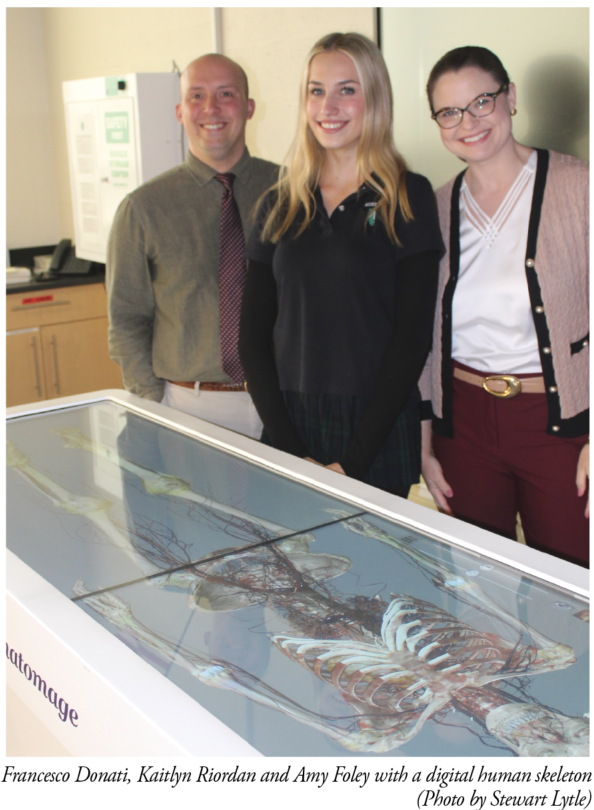
Under the guidance of Amy Foley, Austin Prep’s dean of STEM, the four students modified a robotic arm that can close the hole, a surgery has always been done by humans.
“It is cool to have the kids find a solution that the professionals are working on, but haven’t yet found the solution,” Foley said, beaming.
The year-long STEM immersion concluded with the MEDscienceTECH Surgical Innovation Showcase. Five teams presented original surgical innovations, demonstrated robotic prototypes and made their case for mock investment before judges.
The contest, judged in a TV Shark Tank-like competition, had a total of 19 students make three-minute pitches about their innovation or invention to eight judges, including those from Harvard and Boston University staffs. “The HeartBridge team killed it,” said Francesco Donati, an Austin Prep teacher who is a trained astrophysicist.
For winning first place, Riordan’s team received $20,000 in mock investment money, while the second-place winner was awarded $11,000.
“What we did is design a robot to complete patent foramen ovale surgery, also known as a PFO,” said Kaitlyn Riordan. “What that is, is a small hole in the heart that fails to close after birth.”
A patent foramen ovale is a common, flap-like opening between the upper chambers of the atria. Everyone has this opening before birth, but it usually seals shut during infancy. In about 25 percent, the flap fails to close naturally, resulting in a PFO.
The team demonstrated on a simulated patient who came in with recurring migraines and shortness of breath before being diagnosed with a PFO. The HeartBridge students had their robotic arm guide a catheter through a vein in the leg and up to the heart, using imaging to locate the hole and position a closing device with greater precision.
“Currently, the surgery is not done robotically, which can be risky,” Riordan said. “You have to deal with the heart beating and the muscles of the patient, so you have to make really precise and steady movements.”
The students also proposed improving the robot, adding a long flexible arm adaptation, a grabber tool to insert the mesh closure device and a stabilization system to help control the movement inside the heart.
“One very important addition we think we need for the robot is a stabilization system,” said Jordyn Petitjean. “We need to make sure that nothing that isn’t supposed to be touched is getting touched.”
Projects by the other Austin Prep teams included surgery for removing kidney tumor, brain aneurysm surgery and aortic aneurysm repair.
After the pitches, students showed how their robotic systems worked and answered questions about design, function, limitations and future improvements.
Teams demonstrated movement controls, camera systems, surgical tools, grabber mechanisms and potential upgrades. Judges asked how the devices would be used by surgeons, what improvements were needed, and how the concepts could move from classroom prototype to real-world application.
The program concluded with a graduation ceremony. In addition to the play money, the four team members received a Harvard diploma.
It is the second year that Austin Prep students have been invited to work at Harvard University Medical School to create a bio-engineering project in a competitive environment.
Austin Prep’s STEM courses have scrapped their traditional physics curriculum and focused all the science to robotics. Foley described the new curriculum as “un-siloing” science, letting students learn about chemistry, physics, biology as well as engineering and anatomy, whatever it takes to solve the challenge.
For next year the program has already attracted applications from 50 students. The program has broadened its requirements to include more students, not just those with the best grades. Foley said the school believes that students with lower grades may be better problem solvers. ♦