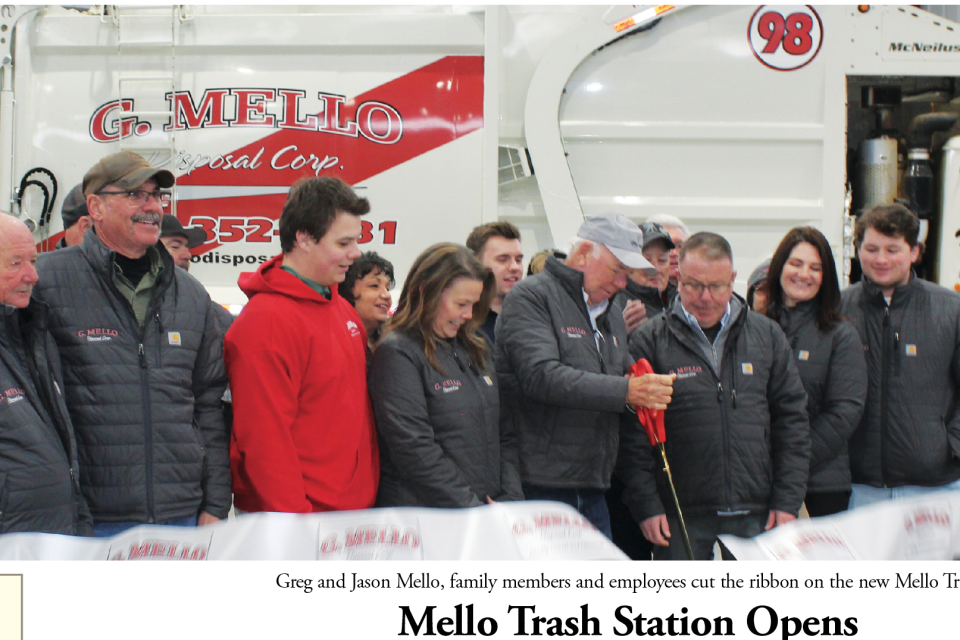
GEORGETOWN – After nine years of what was described as “trials and tribulation,” Jason Mello realized his dream last week of opening the 15,000-square-foot trash transfer station. His father Greg Mello, who started the G. Mello Trash Disposal Corp. in 1978, cut the ribbon as family, employees and a few town officials watched.
Jason Mello said he was told that building this facility was “a pipe dream,” that it would never be built. The nay-sayers, he said, included his father who started the trash company in 1978.
The facility began operations Monday morning, complete with a Georgetown Police officer assigned to the Carlton Road – East Main Street intersection for the next four months.
He praised his team of vendors, engineers and landscape architects for creating the new facility, but singled out Nancy McCann, the attorney for the project, for special recognition. It was she who led the legal battle against staunch opposition from residents and a town board and commission, which initially denied permits to build the facility.
In what Mello vice president Mark Van Weelden called its trials and tribulations, the Planning Board and the Conservation Commission rejected the project initially, saying it was too big and created too many problems for the town in traffic management and environmental concerns.
To build the facility, Mello noted that the construction team was required to re-create 3-acres of wetlands to replace environmentally sensitive ones it removed.
Ultimately, Mello won in state courts, which ordered the Planning Board and Conservation Commission to approve the trash disposal facility. None of the members of the health and planning boards or conservation commission attended the ribbon cutting.
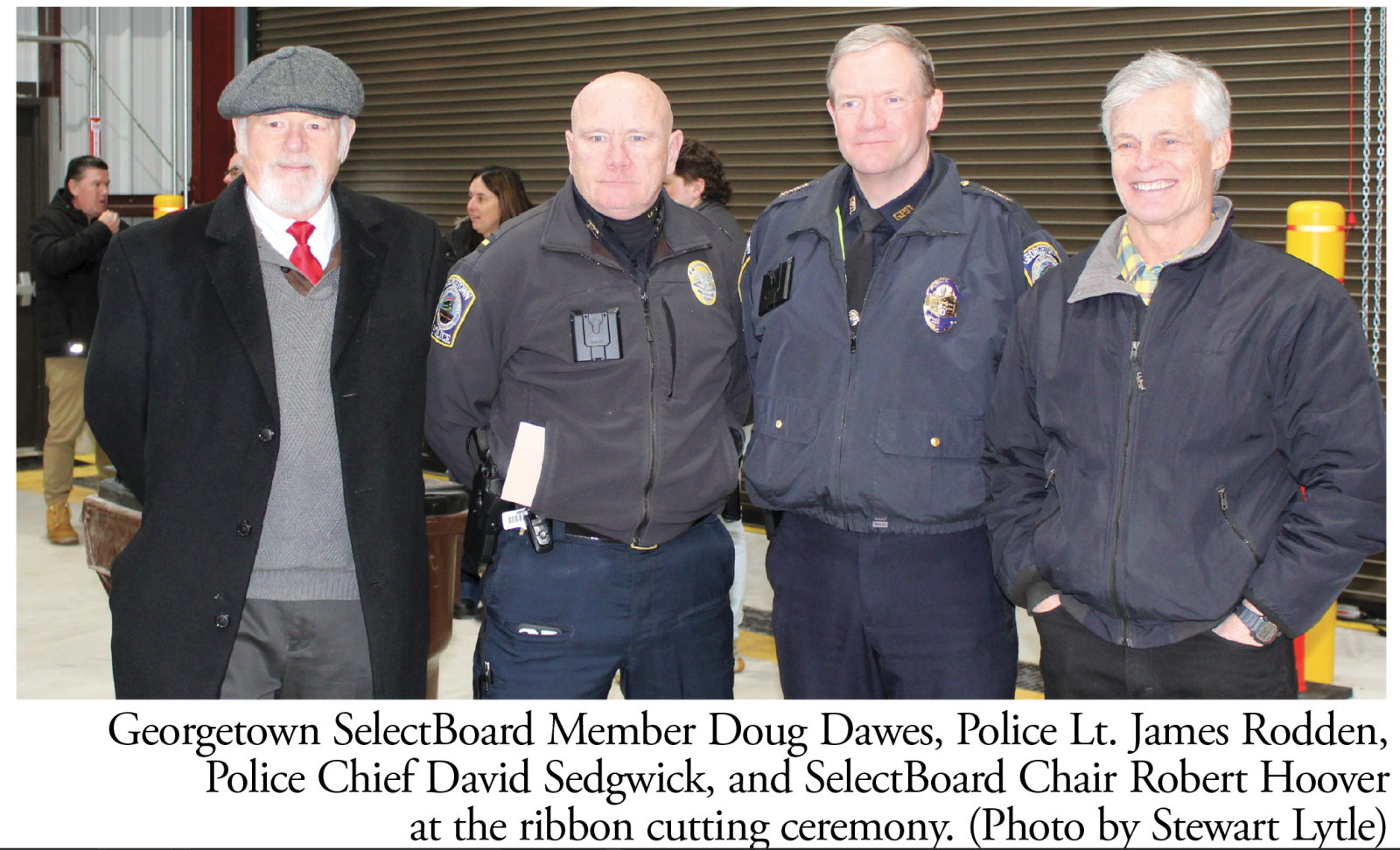
Attending were SelectBoard chair Robert Hoover and member Doug Dawes, Community Preservation Committee member Gary Fowler, plus Police Chief David Sedgwick and Lt. James Rodden.
Mello squashed persistent rumors in town that the corporation was building the facility so the company could be sold to a larger trash disposal company. “I’m not old enough to retire,” he said. “Besides, I don’t want to work for corporate America.”
With the opening of the new facility, the company has 90 days to clean up the old transfer station at 203 East Main St., which is owned by the town. He said he has told Peter Durkee, the public works director, that the scales in the ground at the site and “anything else he wants” could stay for town use.
The new station is limited by the town to 150 tons per day for the first two years. Mello must apply to the town for permission to increase operations to 350 tons for the third year, 450 tons for the fourth year and 550 tons for the fifth year and beyond. The health board could then conduct a review of operations and order changes to the operations within six months after the expansion.
The board required Mello to submit a report every two weeks on how much tonnage is being processed each day at the station. It is unclear if there would be an independent review of those reports.
The highway engineer told the Planning Board that Carleton Road has been rebuilt. It will be striped in warmer weather.
The major concern in town is the increase in large trucks using the Carleton Drive intersection with state Rte. 133 (East Main Street) now that the station is open. The limit on tonnage for the first two years will reduce the number of large tractor-trailer trucks, which will haul trash from the station to incinerators.
In a letter to the town’s health board, Mello wrote: “GMD understands the concerns around truck traffic on Rt. 133 and the safety concerns during AM and PM peak hours. GMD proposes to allow transfer trailers to arrive and leave the site from 6:30 -7:30 a.m. and in the afternoon when school buses are NOT present on Carleton Drive. This proposal is consistent with the Planning Board’s Special Permit which prohibits transfer trailers from accessing or leaving the site during the morning peak hour of 7:30 a.m.- 8:30 a.m. and during hours when school buses are present on Carleton Drive.”
In the first months after the station begins operations, the health board required several independent studies of noise, traffic congestion and odors. Based on the findings of those studies, the board can require more mitigation efforts by Mello. ♦