
by Stewart Lytle, Sr. Reporter
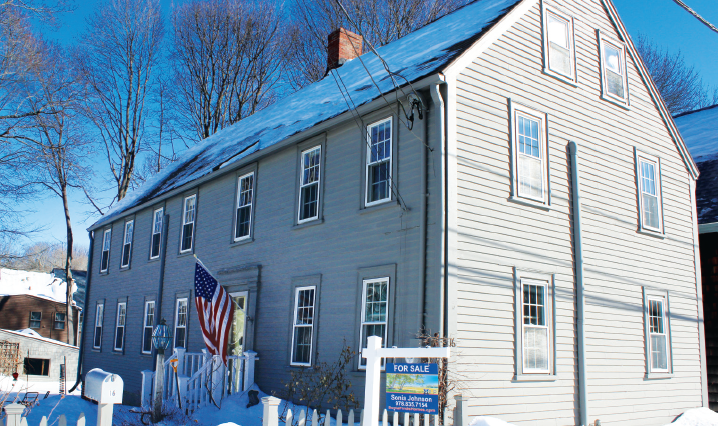
IPSWICH – Few homes in this town that has many First Period homes are more imbued with New England history than the Baker-Tozer House at 16 Elm Street.
Built in 1835, this four-bedroom, 2,750-square-foot home within walking distance of downtown and the Ipswich River can trace its history to the Salem Witch Trials and the Civil War. And its sister house, which stood across Elm Street where the Police Department parking lot is, was disassembled and is now an exhibit in the Smithsonian Museum in Washington, D.C.
Listed by Sonia Johnson with eXpRealty for $799,000, the house could be a single-family or two-family home. She describes the floor plan as “challenging.” But someone who wants to live in Ipswich in a historic home may accept the challenge, particularly the second floor presents, and turn it into a spectacular home.
Johnson has conducted many tours for builders in the 140-plus days it has been on the market, and young professionals have loved the house and its potential. But no one has make an offer because of concerns that the house may require too much investment, Johnson said.
But she believes this house with an investment of $400,000 to relocate some rooms could become a $1.3 million home.
The owners have maintained the house well. The roof was replaced in 2010. New windows were added in 2013. All electrical wiring has been updated, and the house is lead compliant. To make the house a duplex, it needs a second exit. The barn/garage was structurally reinforced and a new roof added in 2010.
It consists of two combined structures. The side facing Elm Street is the house constructed or moved to this location by Samuel S. Baker, and the other end of the house was added later. The house has a central staircase, and the full-height basement features a chamfered summer beam from a first-period home.
The location of 16 Elm, across the street from the Police Station and a short walk to the riverwalk, make this home attractive and likely to get better in coming years. The town is designing a new police station, which will mean the current station will likely be converted another use. And a dam on the Ipswich River is slated for removal, which will open the river all the way to the ocean.
The home, which is not in the National Register of Historic Places, but is included in the Ipswich Architectural Preservation District, has a colorful history.
John Proctor, an early settler in Ipswich, received a land grant along what is now Elm Street. His son, John Proctor, and his wife Elizabeth moved to Salem in 1666, where they were both charged and imprisoned in the Salem Witch Trials. Because the wife was pregnant ,her sentence was never executed. But her husband was hanged with Boston minister Cotton Mather watching as he congratulated the crowd.
Samuel S. Baker, a real estate investor, bought the lot at 16 Elm Street and built a house in 1835. When he became an “insolvent debtor,” the house was sold it to shoemaker William S. Tozer (1804-1860) and his wife Adeline Mears in 1841.
Their son, John M. Tozer, who died of pneumonia in Virginia, while serving in the Civil War, has his name inscribed on the Civil War Monument at Meetinghouse Green. The other son, Joshua, shares a tombstone with John at the Old Burying Ground and is assumed to have also died in the Civil War.
William H. Tozer was one of more than 300 Ipswich volunteers in the Civil War, and at the end of the 19th Century, he owned the Daniel Lummus House on High Street. The family name remains prominent in Ipswich today.
For more information on 16 Elm, contact Johnson at Sonia.Johnson@eXpRealty.com or call/text at 978-835-7154.