by George Comiskey
Georgetown, Mass.
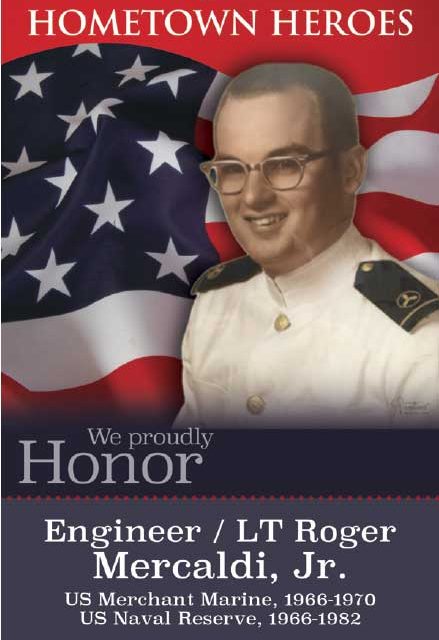
I was glad to see Roger Mercaldi being honored with a Hometown Heroes banner on Library Street in Georgetown for his time in the Merchant Marine and U.S. Naval Reserve during the Vietnam War era. It was a difficult time period when government needed mariners to man vessels, taken out of mothballs and in various levels of seaworthiness, to support the sealift efforts to Vietnam.
I once talked to Roger, who was sitting solemnly on a bench at Harry Murch Park, about his time in the Merchant Marine. It was through Roger’s efforts that the US Merchant Marine flag flies at Harry Murch today.
I did not sail during Roger’s years but did work later with two of his classmates from Maine Maritime Academy, Michael Morrissey and Wally Prendergast, on several ships. Mike was a really good guy. We remained friends for over 20 years until he died too young at the age of 62. Wally was quite a character to say the least.
While sailing with Mike and Wally, I asked them about the sinking of the SS PANOCEANIC FAITH, which took the lives of six Mass. Maritime grads in 1967. All I knew of it was a picture in the academy mess hall of the foundering ship, which seemed to be a warning of what we could be getting ourselves into.
The Mass. Maritime Academy class of 1967 graduated three months early after being asked to assist with the war-time military sealift efforts.
According to Mike, the six were all good friends, enjoying the libations of Cape Cod that summer, when they got the call to join the ship on the west coast heading to the Far East. They jumped at the chance of all working together.
Once joining the World War II-era ship, they could see, despite their inexperience, that there were many problems. Some hatches were covered with tarpaulin and the boilers and main condenser leaked. At sea, the freshwater evaporator produced salt water. Investigators thought they left port without enough fuel to make it overseas. Ten days after leaving port, they ran into a fierce storm, and the ship began taking on water and listing. When the ship lost power, the captain gave the order to abandon ship.
Meanwhile, on another ship, Mike and Wally were caught up in the same storm several hundred miles away. At one point, Mike went out on an upper deck to observe the maelstrom below. The Chief Engineer came up behind him and noticed a door swinging open on the stern. He ordered Mike to go close the door. Mike went down to the main deck and crept cautiously along, timing the waves splashing up on deck. Just as he reached the hatch, a huge rogue wave came towering over him and he dove into hatch, careening 30 feet down the shaft alley escape trunk.
Mike came to under the shaft, the shaft coupling whirring inches from his face. He managed to get from under the shaft, hoist himself up onto a catwalk and crawl, broken and bloodied, 90 feet into the engine room, where Wally found him. The captain wanted to continue across the Pacific, but Wally, fearing for his friend’s life, managed to convince the captain to turn towards port to have him medevaced off.
Back on the SS PANOCEANIC FAITH, the situation turned more dire when the crew couldn’t get the lifeboats lowered. In their haste to leave port, they hadn’t been tested. They threw the life raft into the ocean, but it landed upside down. The crew was tossed into the raging sea. Help would arrive later that night, but only five of the 41 crew members would survive the frigid waters.
The loss of the six young officers from Mass. Maritime would represent about 10% of a graduating class back then. Thinking of the tragedy, I’m reminded of the mournful verse of a Billy Joel song, “And it was dark, so dark at night. And we held on to each other, like brother to brother. We promised our mothers we’d write. We said we would all go down together.”
Two years later, a seventh member of that same group of Cape friends got a job on the SS BADGER STATE, another WW II-era military sealift vessel. Seeing that it was in bad shape and remembering the fate of his friends, he decided to get off before it left port. The ship encountered a raging gale, causing some bombs in its hold to shift and explode. This time the seamen managed to lower a lifeboat into the water, but just then, a 2,000-pound bomb fell out of a hole in the ship and crushed the 35 men in the lifeboat.
Throughout our nation’s 250th year history, from the brave privateers of the American Revolution to modern times, the U.S. Merchant Marine has played an important role in supporting our military. We must never forget their sacrifices. ♦