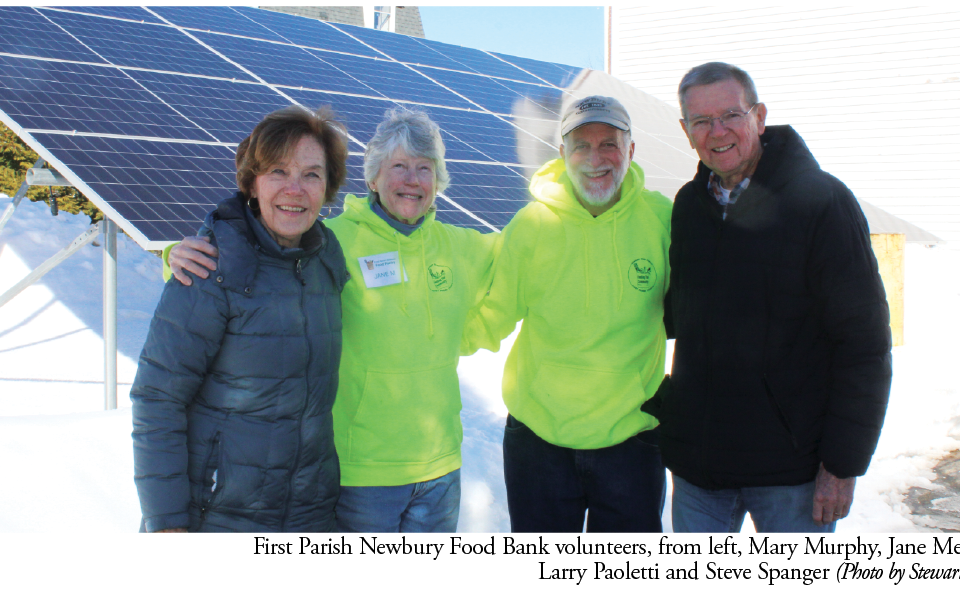
NEWBURY – The First Parish Church already taps the sun’s rays to grow vegetables in its gardens at the rear of the church lot. Now the church’s food bank is turning to the sun again for power to operate its freezers and refrigerators that store the food it distributes to those in need.
The First Parish Newbury Food Pantry has installed 52 ground-level, bifacial commercial-grade solar panels that it expects will generate enough electricity starting this spring to power its six freezers and six refrigerators and keep the church’s lights and air conditioning on.
It is a trend, supported by the state government, that is helping food banks reduce their utility costs, which allow them, as Jane Merrow, the food bank’s lead volunteer, said, to “buy more food.”
Last year, the state’s Department of Energy Resources’ Low-Income Services Solar Program awarded grants to three food banks across the state. The solar installations will produce almost 460 kilowatts (kW) of electricity. Together, the solar systems are estimated to save the nonprofits $234,800 each year in energy costs by generating an estimated 745,195 kilowatt hours of electricity.
The Newbury food bank, which distributes 12,000 pounds of food each week to more than 750 clients in several North Shore communities, spent more than $800 a month on electricity last year. The system, divided into two arrays, is capable of producing 26.6 kW of AC power.
Volunteer Larry Paoletti, nicknamed “the inventor” by Merrow, predicts that by March or April, when the sun is closer, the system will generate enough electricity to reduce the utility costs for the food bank and the church to zero. “Time will tell,” he said.
The arrays, which were turned on Dec. 30, are located between the church and the rear parking lot and between the organic gardens and the pre-school playground. The design team ruled out placing the panels on the church roof.
“It was just too high,” said Steve Spanger, a member of the church property committee and long-time advocate of using solar power at the church. The concern was that snow and ice from the panels would fall dangerously from the steep roof.
In addition to the church activities and the food bank, which distributes food on Fridays, the church operates a pre-school, the Secret Garden.
Finding space on the church’s well-utilized lot for the solar arrays proved to be a bit of a challenge, Merrow said. But the project was well supported by the congregation.
Both sides of the commercial-grade panels tap the sun’s rays. The panels collect sunlight directly on the top side and on the bottom side from reflection off the ground. The team is planning to install white rocks this spring under the panels to reflect more of the sun’s rays.
The system, installed by Porter Electrical Contracting in Deerfield, NH, cost about $110,000, but the non-profit food bank has applied to the state for a grant that should reimburse it for 33 percent of the upfront costs. Predictions are that the system will pay for itself in five to seven years, which is better than the usual 10-year payback, Paoletti said.
“It’s a good investment,” Merrow said, who noted that the mission of the church is to be Good Stewards of the Earth and Spirit.