AMESBURY – On Oct. 30, the Amesbury Fire Department was called to the Amesbury Innovation High School (AIHS) to check out the smell of gas in the building. That call has since created a major challenge for the school district, headed by Mayor Kassandra Gove, and the parents and the approximately 50 students who attend AIHS.
The firefighters found a water leak from a steam radiator in one class and a failed heater in the basement. They also discovered that a pressure relief valve in a boiler had caused major damage to the fire alarm control panel, which as one teacher said, “fried the fire alarm.”
Fire Chief Robert JH Serino declared the education building of the All Saints Anglican Church at 71 Friend St. to be too dangerous for the students and faculty to continue attending school there, and that was before the inspectors found asbestos. The school was relocated to the City Hall auditorium for the day and in a few days to the second floor of the Amesbury Middle School (AMS).
KP Law, Amesbury’s attorneys, wrote to the church that it had breached the lease, specifically the implied warranty of habitability. That created fear in the community that the move to AMS could be much longer than the six weeks initially promised.
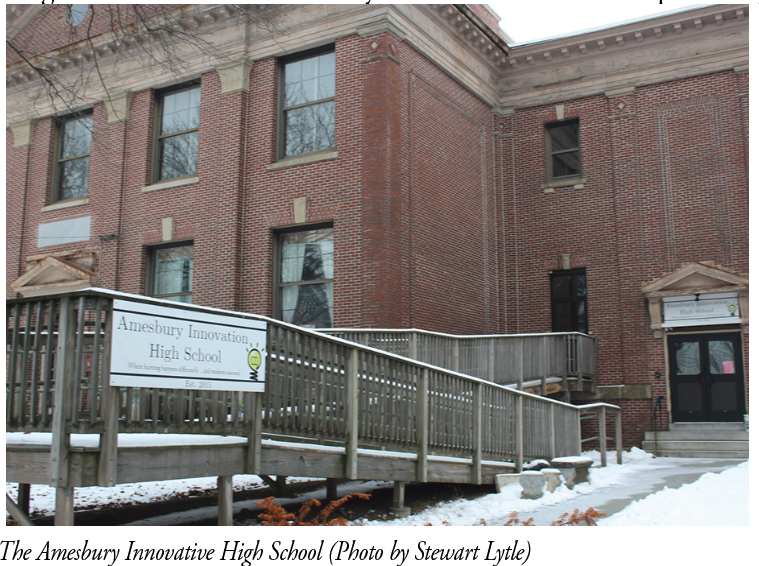
The district got the AMS space ready for the students in two days, which a parent, Christine Wade, called “amazing.” But being back in the Middle School has caused considerable angst among the students and faculty, which erupted last week in a School Board meeting.
Parents, staff and several students, who came to the board meeting thinking the district might cancel the lease permanently, asked that the district postpone any vote. The mayor said there would be no vote until the board had more time to discuss the issues.
Founded in 2001 as the Amesbury Academy of Strategic Learning, a Horace Mann Charter School, AISH students are held to the same benchmarks and standards as students in other public high schools, according to the district’s web site.
“However, at AIHS we take the time to build individual plans for students based on their academic ability and learning style. This individualized approach builds confidence academically, as well as socially and emotionally,” the district wrote. “Often students have not felt successful in school for a number of years when they enroll at AIHS. Once their confidence starts to return, students become available to learning. Over their years with us, they push themselves beyond what they believed they were capable of.”
The school continues to be at the forefront of education academically and therapeutically, the web site states.
At the board meeting, staff, students and parents complained that the Middle School space is too small and has little room for small group projects and individual therapy. They also expressed concern about the lack of communications between the district and the families and about the emotional trauma some students feel being back in the Middle School.
Wade said her daughter, who loved going to school before has been so depressed, she is often late or skips school.
One student, Violet, said she experienced a traumatic event while a student at the Middle School years before and cannot concentrate in the same room where the undisclosed event happened.
“High schoolers don’t belong in middle school. We need our own space,” Violet said. “This is not where they want to be.”
Parents and teachers praised the Innovation School as being “transformative” for the students. Other parents complained that the Innovation School students are considered “a budgetary problem.”
Dan Swanson, a teacher, said the students were told they would be returning to the church building. “They have grown up on broken promises. The district must keep its promises,” he said.
Several teachers said the students have proven to be resilient, but reported that absenteeism, negative behaviors and a general malaise in student attitudes are on the rise since moving to the Middle School.
One teacher Invited the board to visit his classroom. “It is the only way to understand what is happening,” he said. Board member Greg Noyes has visited the school recently.
Cindy Collins said the students are not optional. “If classes are closed or destabilized, it will not be because asbestos was found. It will be because of the district’s priorities.”
Other parents were even more angry at the prospect of their students staying at the Middle School. One shouted from the back of the room, “If we can have a new office for the mayor, why can’t these students have a school of their own?”
The city is moving to a portion of the old Provident Bank headquarters in January.
Complicating the return to the church, inspectors on the day of the board meeting found asbestos in the building, which must be remediated. As a result, the building was deemed a potential health hazard until full air-quality testing and a comprehensive sampling for asbestos and lead paint is conducted.
For a future council discussion on the school, Mayor Gove distributed to the council and audience a copy of the lease, which provides for the rent at $9,500 a month this year, $10,000 a month next year and $10,500 a month the third year, if the district renews it.
A reinspection was scheduled on Nov. 12, but was halted because several repairs had not been completed. In a letter, the fire chief wrote that conditions in the basement raised serious safety issues. A pressure test had not been performed on a boiler that had not been serviced since 2020. And a pressure test must be conducted to verify that the heating system for the entire building can be operated safely and effectively. ♦