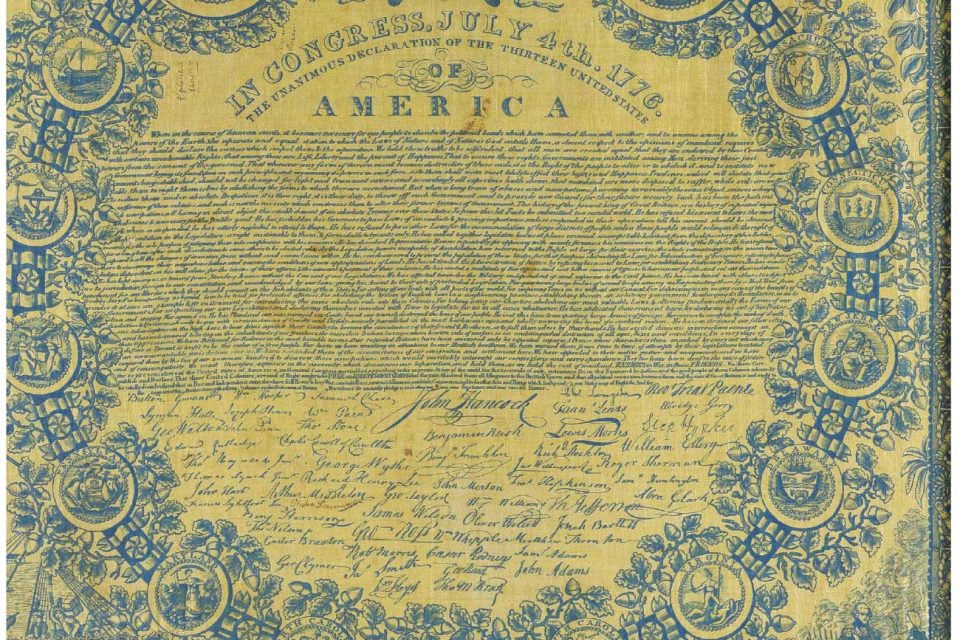
NEWBURYPORT – It was a tense morning at the Custom House Maritime Museum, the adrenalin and hot caffeine flowed as executive director James Russell, his team and a very special donor competed in the Eldred Auction for a rare patriotic textile of the Declaration of Independence.
On Cape Cod, Eldred’s, New England’s oldest continually operating auction house, had listed a cloth, printed on copperplate in Glasgow, Scotland between 1820 and 1825 by Richard and Colin Gillsepie.
“The more we researched it. The more excited we became,” Russell said last week.
It was brought to the museum’s attention by an anonymous benefactor, who had discovered the Custom House and its collections during the museum’s Revolutionary War exhibit last year. He thought this textile would be a perfect addition for the museum, which is building a “critical mass” of Revolutionary War Americana pieces.
The indigo blue Gillespie Declaration is among the earliest and most visually elaborate textile representations of America’s founding document. Printed on cambric, a fine, dense linen material, the textile measures 31 inches by 27.5 inches. It is called a handkerchief, but is more like a table runner, Russell said.
There are probably only three blue versions of the Declaration in existence, a few more in mulberry and brown for a total of no more than 12.
All known Gillespie patriotic textiles have a distinctive and richly symbolic composition. At the center is the full text of the Declaration of Independence, accompanied by facsimile signatures. Surrounding this is an oval oak-leaf wreath featuring medallions representing the original thirteen states.
Below the text of the Declaration are portraits of George Washington, Thomas Jefferson and John Adams beneath a prominently displayed American eagle. Decorative vignettes in the lower corners depict key Revolutionary War moments, including the Boston Tea Party and the surrender of British Gen. John Burgoyne at Saratoga.
In corners of the textile are the words, e pluribus unum, originally the words clutched in the eagle’s beak on the Great Seal of the U.S. In another corner is the word Fate, which references Washington’s rallying speech to the Continental Army before the battle of Long Island in August of 1776.
The full quotation was: “The fate of unborn millions will now depend, under God, on the courage and conduct of this army. Our cruel and unrelenting enemy leaves us only the choice of brave resistance, or the most abject submission. We have, therefore, to resolve to conquer or die.”
The museum is planning to do more research on the meaning of the images in coming months, Russell said.
Initially the patriotic textile was expected to sell at auction in the $4,000 to $6,000 range, he said. But that valuation proved to be very low as other bidders discovered how rare the piece is and boosted the price.
After a nail-biting session, the donor secured the textile for the Custom House for $55,000. With auction house commissions and fees, the final price was $69,300.
“We were successful,” Russell said with pride. He added, “This acquisition, coming as we celebrate the 250th anniversary of the signing of the Declaration of Independence, is exceptional.”
Bob Cronin, chair of the museum, agreed, “This textile represents a remarkable opportunity to deepen public understanding of how Americans in the early republic engaged with their founding ideals.”
The patriotic textile is now undergoing conservation, a light cleaning and reframing, at the Museum Textile Services of Andover. It will be ready for viewing at the museum’s annual meeting.
Adding to the collection of Revolutionary War Americana, the museum acquired last week a rare map by Frenchman Joseph F. W. Des Barres of the Merrimack River, Plum Island and Ipswich Bay as they were in 1776.
“The Custom House Maritime Museum, in partnership with the Museum of Old Newbury, will unveil a major exhibition focusing on 1776, titled Ink, Iron & Independence. The icon textile will be accompanied by a portrait of George Washington, which is on loan from the Newburyport Public Library and other artifacts honoring our first President such as two exceptional scrimshawed whale teeth with engravings of Washington and his home and tomb at Mount Vernon,” Russell said.
Adding to the collection of Revolutionary War Americana, the museum acquired last week a rare map by Frenchman Joseph F. W. Des Barres of the Merrimack River, Plum Island and Ipswich Bay as they were in 1776.
The museum is located at 25 Water St. in downtown Newburyport. For more information, visit customhousemaritimemuseum.org. ♦