NEWBURYPORT – Parker Jackson, an intern at the Custom House Maritime Museum, had been working at the museum for about a year and a half when he was dispatched last month to organize the paintings and artifacts in the museum’s attic.
The great, great grandson of George Jackman, who built 12 clipper and other ships in the 18th century and served as Newburyport’s mayor for four terms, was not expecting to make one of the museum’s most exciting finds.
After arranging paintings on shelves and moving several boxes, the Newburyport High School freshman opened a remaining box to find a rolled-up paper document. Surprised and curious, he worried that the obviously old paper, which felt like leather to his touch, would fall apart in his hands when he unrolled it.
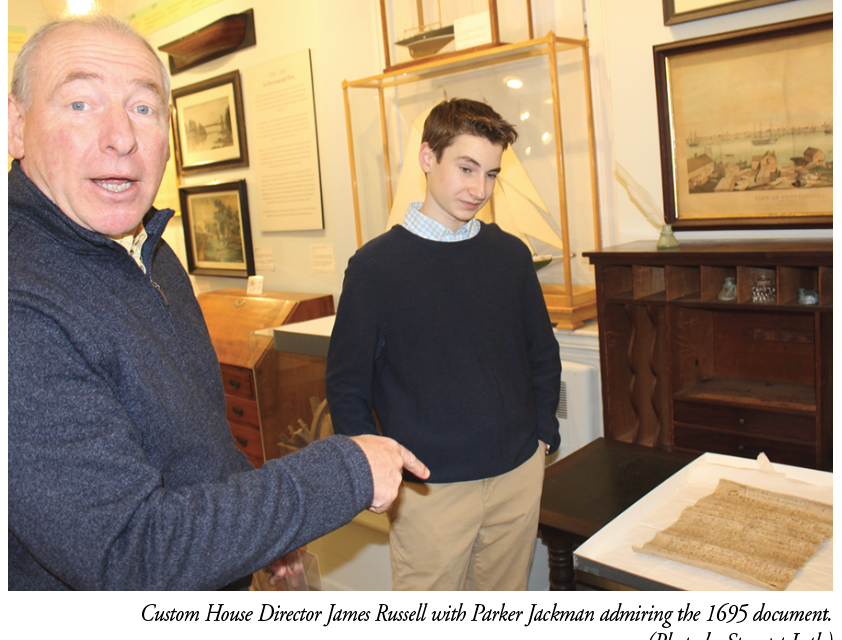
First, he noticed it had a stamp on the bottom making it an official document. Though some of the lettering in what later was determined to be written in iron gall ink was beginning to rust and blur, the document turned out to be a 1695 deed for land in Salisbury. In what is now known as Ring’s Island, the deed transferred 100 acres of upland and marsh.
He carried the document to the museum director James Russell. When they studied the one-page document, “we were awestruck,” Jackson said. “It was out of the blue, so unexpected.”
The maritime museum, which traces its history to Alexander Hamilton, the treasury secretary, who commissioned 10 ships, including the USS Massachusetts to patrol the Atlantic coast for smugglers, has thousands of documents in the historic building on Water Street. Many of them are on display.
But none are older than the deed signed by William Hooke, a Salisbury landowner, to Capt. John March of Salisbury, a militia leader, land owner and entrepreneur, who established a ferry in 1689 across the Merrimack River between Ring’s Island and what is now downtown Newburyport.
The Merrimack Valley Transit Authority (MeVa) is building ferries now to carry passengers across the river and upriver to Haverhill.
Russell asked Ellie Bailey, a museum board member, Ring’s Island resident and museum educator, to provide background on the document.
“The bounds of the land described in the deed begin at the ferry gate, today the site of the Ring’s island Town Pier, and stay on the left-hand side of the road to Salisbury – Second St. on Ring’s Island then Ferry Road. The 100 acres are to the left of the road and bounded by Vincent’s Creek,” Bailey wrote.
According to Bailey, the deed came from Robert K. Cheney, who wrote in an unpublished History of Ring’s Island, “John March bought land of William Hook in 1695, including upland in Salisbury and the marsh to Mill Creek, according to the original deed in the author’s possession.”
The deed will now be encased for its protection from the elements and displayed in the museum’s front room.
This is not the first contribution Jackson has made to the museum. When he started his internship, he was in the seventh grade at River Valley Charter School. He found stored in the museum a small collection of whale bones, including a long jaw bone, which he assembled in a display that now takes up a large section of a museum’s basement wall outside the director’s office.
To make the jaw bone look more realistic, he used a 3D printer to produce amazingly authentic looking whale teeth.
Jackman’s family has been involved in shipbuilding in Newburyport since 1790. In 1849, George Jackman purchased the shipyard of his deceased brother, Stephen and launched his first vessel, the Hollander, a 525-ton bark. In 1850, he constructed his first clipper ship, the 525-ton Arab.
The younger Jackman, who grew up driving boats on the river, said he applied to be a museum intern because he is fascinated with Newburyport’s rich maritime history. His passion is bringing historical artifacts forward in the modern world, where they can be studied.
His great, great grandfather, who was the Customs Collector and worked in the Custom House collecting revenue on imported cargoes, would be very pleased. ♦