NEWBURYPORT – Anyone who has ever built a deck or porch can relate to the dilemma the city finds itself in trying to rebuild its popular boardwalk for the next quarter century.
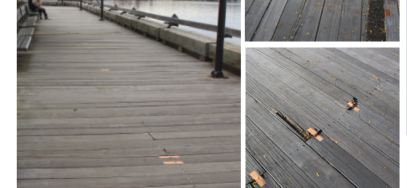
The boardwalk along the Merrimack River waterfront has deteriorated in recent years with rotting and warping boards and substructure stringers plus broken fasteners, screws and nails that create tripping hazards for those trying to enjoy a walk along the river.
Built originally in the 1970s and rebuilt in 2001, the city chose to use Southern pine boards, which are prone to splintering. And the quality of some of the fasteners that held the boards to the substructure “were not the best quality,” said senior city planner Geordie Vining.
Planning to rebuild the boardwalk for the next quarter century, the city has decided it needs to continue using wood boards because it matches the aesthetics of the city. But what kind of wood? And should it try to salvage some of the existing boards to cut costs?
In a presentation to a couple of dozen residents last week, marine engineering consultant GEI, which helped rebuild the bulkhead beneath the boardwalk, outlined three alternatives.
The city could opt to continue repairing broken boards and fasteners, as the Waterfront Trust and the city’s Department of Public Services have been in recent months. It could replace the north and south ends of the boardwalk, the most deteriorated, while using existing boards on the central section. Or it could replace the entire boardwalk with new boards and substructure.
To save money, which would likely come from state and non-profit grants, GEI is recommending that the city replace the north and south ends and use existing boards that still have years of life for the boards on the central waterfront, mainly around the embankment.
But then, what wood should be used?
If the city chooses tropical hardwoods like Brazilian ipe or purple heart, it would be expensive, about $1.7 to $1.8 million and would be subject to fluctuations in tariffs and longer supply time. But they would require less maintenance, the engineers said.
Softwoods like the current southern pine would be less expensive, about $1.3 million, but the wood would have a shorter life span, be prone to warping and splintering and require more maintenance.
Composite boards have a 30-to 50-year lifespan, use recycled materials, offer good traction and require minimal maintenance. To rebuild the northern and southern ends of the boardwalk in composite wood would cost about $1.5 million.
GEI’s Dan Robbins said it would take three to five months to build each of three sections of the boardwalk, which translates into a year of construction. The tentative plan is to replace 60 percent of the boards and stringers beneath, while reusing about 40 percent of the current boards.
Vining said the good news is that the new Market Landing Park has a shared path nearby, which would allow pedestrians to view the river even while the boardwalk is being rebuilt.
GEI is expected to complete its feasibility study for the boardwalk by year’s end. There is no estimate on when the boardwalk construction might begin, which depends largely on when the city can secure grant funding.
The feasibility study can be viewed on the city’s website.