Let us just burn Burning Bush.
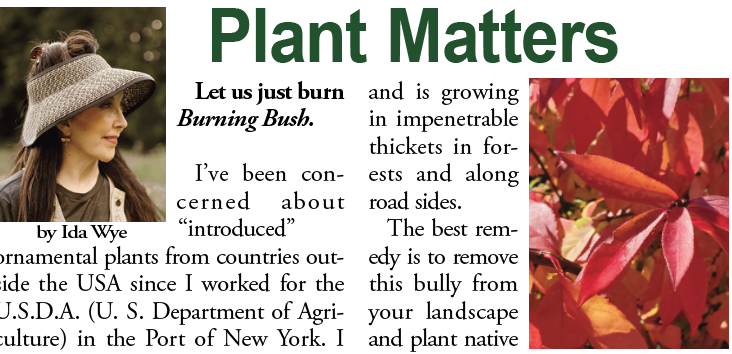
I’ve been concerned about “introduced” ornamental plants from countries outside the USA since I worked for the U.S.D.A. (U. S. Department of Agriculture) in the Port of New York. I have been working in the green industry over the last four decades and have become alarmed by the negative impact that ‘invasive’ ornamental plants have had on local ecosystems. One shrub that has been classified as a significant threat to local ecosystems is Euonymous alatus which was introduced from Asia. This shrub – commonly known as Burning Bush or Winged Euonymous – is prized for red and persistent fall foliage. Masses of these plants have been deliberately planted from parking lots to suburban plots.
So how did this plant become a menace to local ecosystems? It can grow almost anywhere, from deep shade to full sun, in any soil type as well as from dry to wet conditions. It is such an unappealing meal to wildlife that even deer abhor it and do not impede its rampant colonization. This miscreant is successfully competing with native plants that are essential for forest succession and bird migration. Climate change is providing a strategic advantage to Burning bush. Birds need vital calories for successful migration and are migrating later due to climate change, but many of the native plants that provide the most nutrient dense berries are ripening before birds begin their journey. Consequently, birds are consuming berries that are produced later and are more persistent. Burning Bush berries are abundant at this crucial time but provide less nutrition. Birds must eat more of these berries and, inadvertently, consume and disperse Burning Bush disproportionately to native plants and is growing in impenetrable thickets in forests and along road sides.
The best remedy is to remove this bully from your landscape and plant native trees and shrubs that provide outstanding autumn colors and high functional value to our shared ecosystem. The following is a list of native plants to consider adding to your landscape.
Trees
Oxydendrum arboreum ~25’
Nyssa sylvatica ‘Red Rage’ ~40’
Amelanchier x grandiflora
‘Autumn Brilliance’ ~20’
Shrubs
Viburnum prunifolium ~12’
Viburnum cassinoides ~6’
Aronia Arbutifolia
‘Brilliantissima’ ~8’
Vaccinium corymbosum ~5’
Fothergilla major ~8’
Small Shrubs
Fothergilla gardenii ~3’
Aronia melanocarpa
‘Low Scape Mound’ ~3’
Rhus aromatica ~2’
See also: Free List of Native Plants for New England Gardens, Umass Extension Landscape, Roberta Clark. •
Ida Wye is the principal of Ida Wye Designs, offering landscape design, consultation, implementation, and restoration. Ida was green long before it was fashionable. She is committed to creating gardens that heal our planet, one landscape at a time. Ida graduated from U. Mass. Amherst with a B. S. in Plant and Soil Sciences before working for the U.S. D. A. and teaching Horticulture. After studying Landscape Design at Radcliffe, she began working independently. She later studied Urban Forestry and Wetland Science. www.idawyelandscapes.com